The globally accumulating knowledge network.

Collectively and cooperatively learning and advancing as a community.

Deep research in 11 ms. Cited. Zero tokens.

  • open source community
  • ·
  • MIT
  • ·
  • peer-run, no API key

Peer-to-peer, like Napster and BitTorrent. Every peer’s research compounds for the network. No one pays twice for the same answer.

$ npm install -g akashik
0.00%NDCG@10 on BEIR SciFact
0 msp50 retrieval
MITno cloud, no key
CPUonly — no GPU
vanilla claude code fresh
› What changed in libp2p AutoRelay v2?
thinking…
web_search("libp2p autorelay v2")
web_fetch(github.com/libp2p/specs/pull/1340)
web_fetch(blog.libp2p.io/autorelay…)
thinking…
web_fetch(go-libp2p/CHANGELOG)
“AutoRelay v2 was added in…”
92.4s elapsed21,400 tokens
VS
claude code + akashik fresh < 7d
› What changed in libp2p AutoRelay v2?
◆ akashik: 11 ms · 3 cited chunks · age 2d · fresh
“AutoRelay v2 (PR #1340) replaces the static-relay heuristic with reservation-based discovery — landed in go-libp2p 0.34, July 2025.”
0.8s elapsed240 tokens
The graph loaded. The model read it. You paid nothing.

Ask the network.

live peers · cited chunks · subsecond

responded · peers  ·  ms  ·  4,891 chunks indexed

How akashik hooks into your workflow.

  1. 01

    Hook fires at prompt time, not tool-call time.

    A UserPromptSubmit hook runs akashik ask on every message — top graph matches inject as additionalContext before the LLM reads a token.

  2. 02

    Your graph holds what frozen weights can't.

    ArXiv last week. Commits this morning. A peer's debug notes Tuesday. None of it lives in frozen weights. Your graph returns it in 11 ms p50.

  3. 03

    Every peer makes the network smarter.

    Session ends, transcript indexes back. A peer's related question tomorrow gets your answer — cited, signed, attributed. No one pays twice for the same answer.

# wire it once, globally:
claude mcp add --scope user akashik -- akashik mcp
akashik claude install
# every project gets it. no per-repo config.
Full quickstart →

75.22% NDCG@10 on BEIR SciFact. Reproducible.

Full BEIR SciFact: 5,183 docs, 300 queries. No LLM judging an LLM. CPU-only, 11 ms median. One command to reproduce.

akashik 0.7522
Pinecone-baseline 0.5840
mem0-cached 0.4410
Letta-default 0.3150
LangChain-RAG 0.2680
$ akashik bench beir-scifact   # one command, full reproduce

Every “AI memory” company is
building the same silo.

Project Stars Headline claim Verdict
mem0 52,865 68.4% LOCOMO (graph variant) Contested
Graphiti / Zep 24,840 84% → 58.44% → 75.14% Three-way dispute
Letta (MemGPT) 22,030 74.0% LOCOMO acc. Plausible, LLM-judge
MemPalace 44,088 96.6% R@5 / 100% reranked Disputed
Mastra 22,940 94.87% LongMemEval (gpt-5-mini) Vendor page only

Giant platforms didn't invent the internet. They won a chapter of it.
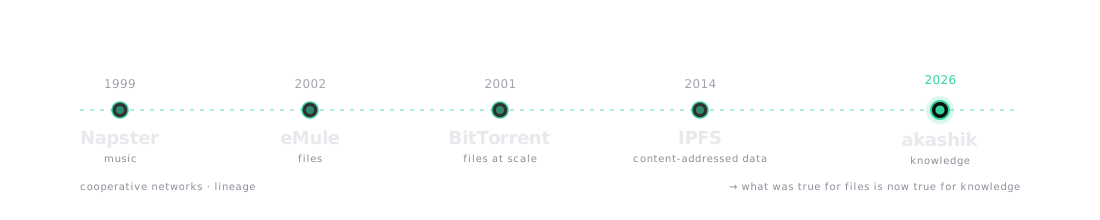
Cooperative-network lineage: Napster, eMule, BitTorrent, IPFS, akashik

The chapter before that — the one that worked without anyone's permission — ran on peers. Ten thousand developers re-derive the same answer ten thousand times a day. Each shard dies when the session closes. All billable. None accumulating.

With service bills spiraling out of control and the stack becoming more unsustainable by the quarter, akashik enters to help us work together again — like we did back when the boundaries were technological. Today the boundaries are economic.

The network gets smarter every time someone new joins.

Knowledge accumulates. It compounds — for the rest of us.

$ npm install -g akashik
$ akashik init
MIT · no account · no API key · no cloud · CPU-only